Florida Literacy CoalitionFlorida Literacy CoalitionFlorida Literacy Coalition


Health Literacy


Florida Health Literacy Initiative


Florida Literacy Coalition (FLC) is proud to partner with Florida Blue to make available targeted grants to promote health literacy. The goal is to provide health-education resources for local adult English for Speakers of Other Languages (ESOL) and family literacy programs so that students in these programs can make informed choices about their health and nutrition.

All adults need an adequate level of health literacy to establish good communication between patient and health care providers. According to the U.S. Department of Education, almost 50 percent of adults who don’t finish high school lack basic health literacy. These people are also more likely to suffer from chronic conditions and be unaware of how to manage their disease(s).

For more information of the Florida Health Literacy Initiative, click here.


Florida Health Literacy Initiative Video


Health/ESOL PowerPoint


Teaching Health to Low-Literate Adult ESOL Students (PowerPoint)

Lori Cabrera, ESOL Department Head, East & West Area Adult Schools, Polk County

Learning English as a second language can be daunting for those with limited literacy in their native language, especially when it comes to health.  This presentation explores the issues ESOL learners encounter when developing health literacy, strategies to address these issues, and how to adapt Staying Healthy and other curricula for low literacy-level students (webinar originally presented December 11, 2012)


Presentations from the 2012 Florida Literacy Conference: Health Literacy Track

Promising Practices in Health Literacy: Panel of Selected Florida Health Literacy Initiative Grantees


English for Health: Developing and Promoting Health Literacy Partnerships
Beth Gaytan, Literacy Network


Health Literacy: Challenges & Solutions
Nancy Patterson, National Network of Libraries of Medicine (NNLM)


Applying a Health Literacy Lens to Learning Materials
Erika Heiges, Health Ed


Say What? (Health Literacy: Bridging Communication Gaps)
Chris Tittel, Monroe County Health Department


NEW Health Literacy Curricula

FLC Releases New Women’s Health and Coping with Stress Curricula, July 2010

Through the generous support of the Florida Department of Education, the Florida Literacy Coalition is pleased to make available two new health literacy student resource books, each with a corresponding teacher’s guide.  These publications compliment FLC’s Staying Healthy curriculum by focusing on two issue areas identified by teachers and students as topics of interest.

The Women’s Health resource covers topics including menstruation, menopause, pregnancy, childbirth, breast and reproductive cancer, sexually transmitted infections and domestic abuse. The Coping with Stress supplement covers stress, the effects of stress on the body and healthy ways to manage one’s stress.


Coping with Stress
Student Resource Book
Teacher's Guide
Women's Health
Student Resource Book: Full Version
Student Resource Book: Part 1, Healthy at All Ages
Student Resource Book: Part 2, Stay Healthy, Stay Safe
Teacher's Guide
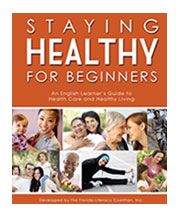
Staying Healthy;
An English Learners Guide to Health Care and Healthy Living
Student Resource Book
What is this book about?
Ch. 1: Health Care
Ch. 2: Your Doctor
Ch. 3: Medicines
Ch. 4: Nutrition
Ch. 5: Chronic Diseases
Ch. 6: Staying Healthy
Glossary and Index
Teacher's Guide

Order Staying Healthy:


While Staying Healthy is freely available to download, many programs like to provide students with their own high quality print copies. Get your glossy, bound, full color books today!

Florida Literacy Programs: A supply of hard-copy health literacy books are available for free to Florida adult ESOL and literacy programs. Please complete this Request Form to get your free copy.

Other Programs:  The Staying Healthy student resource book and several other related publications are available to schools and non-profit organizations to purchase. Click here to view the order form.

What Teachers Are Saying About Staying Healthy Curriculum and Materials:


"Thank you for such beautiful, user-friendly, and accesible materials dealing with vital health issues!"
- Anne Meisenrahl, Tallahassee

"I am finding Staying Healthy to be an excellent resource. It is comprehensive and informative. It is colorful, engaging, and written in a way that high beginning to intermediate language learners can readily understand."
- David Heit

"A comprehensive guide to help ESOL students become confident and self-sufficient while gaining control of their health."

"Staying Healthy has really impacted my students. They tell me it is easier to go to the doctor and understand what he/she says. One student even brought her new medicine to class to show us!"
- Stephanie David, West Palm Beach


These publications were made possible through the generous support of the Florida Department of Education, Division of Career and Adult Education.


Special thanks to Sabrina Kurtz-Rossi, Martha A. Lane, Julie McKinney and Jordana Frost for their tremendous efforts in developing these materials.

Staying Healthy student resource book and teacher’s guide may be freely downloaded and duplicated for non-commercial purposes.


Additional Health Literacy Resources:


Webinar: Teaching with Cultural Differences in Mind: A Women's Health Curriculum for Adult Learners
October 21, 2010

Florida Health Literacy NING
An online social networking site where health literacy practitioners and stakeholders can come together, access resources, and share challenges and successes.

Sample Pre-Knowledge Assessment Test
Sample Post-Knowledge Assessment Test

Teacher Evaluation Form

Student Survey

Staying Healthy Project Summary Report

Health Literacy Sites Worth Checking Out.


Promising Practice in Health Literacy:
English for Health


English for Health
is a 12 week course that works from the text, Staying Healthy.  The program is held in hospital and clinic settings. Adult English language learners study how to navigate the health care system, communicate with health care staff and professionals (with a focus on patient rights and responsibilities), read medicine labels and adopt good health habits.  The class provides students hands-on practice that will improve their English language ability, knowledge of good health practices and their ability to make and communicate good decisions regarding their health care. Throughout the course area health care providers come to speak with the class on a variety of health related topics, ranging from accessing low cost healthcare to flu prevention.  In addition, the class takes fieldtrips that are of interest to the current group of students, such as a health foods supermarket or a community clinic.  The culminating activity is a mock clinic, where students practice interactions with nurses, practitioners and pharmacists. The clinic experience is simulated as students make a doctor’s appointment, fill in new patient forms, meet with a provider to learn about their blood pressure and describe symptoms and then finally speak with a pharmacist about a medical prescription. 

The course provides childcare, the Staying Healthy text and other course materials to all students, free of charge.

The English for Health program was named a “promising practice” by the State of Wisconsin to improve minority health outcomes in 2010.  The program also received the first Outstanding Achievement in Health Literacy from Wisconsin Literacy in 2010.

For more information: 

Literacy Network
Beth Gaytan, Health Literacy Director
(608) 244-3911
beth@litnetwork.org


Last Updated: 06/21/12

Sign up to be notified of page updates.
it's private
Please note: Change notifications will be emailed from
ChangeDetection.com instead of Florida Literacy Coalition.


Ambassadors

The Florida Literacy Coalition thanks the Florida
Department of Education, Division of Career and Adult Education
for making this site possible.
 

.Florida Literacy Coalition
..250 N. Orange Avenue

Suite 1110

Orlando, FL 32801
..Phone: (407)-246-7110
..Fax: (407)-246 - 7104

Florida Literacy Hotline
(800) - 237 - 5113